How GPS Works — and Why We Take It for Granted

You tap an address into your phone, a blue dot appears, and turn-by-turn directions begin. The Global Positioning System feels like magic — a free, planet-wide utility accurate to a few meters. It is also one of the most remarkable engineering achievements in history: two dozen satellites, atomic clocks, and Einstein's relativity, working together so you never get lost.
And almost nobody thinks about how it works.
Satellites, clocks and triangulation
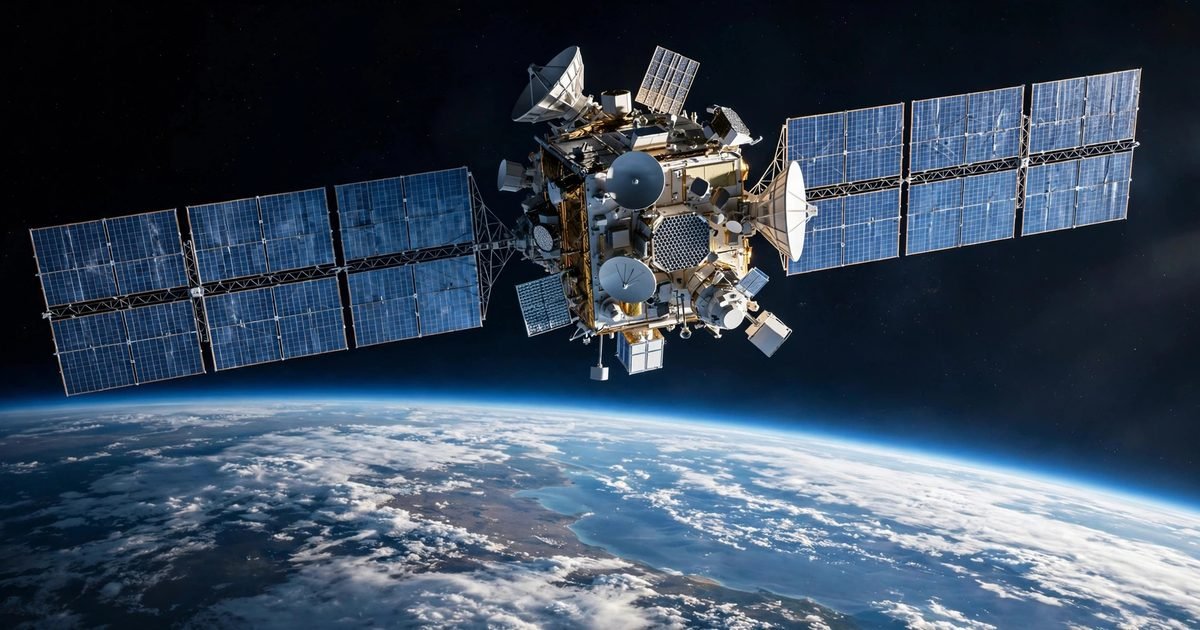
GPS is a constellation of satellites orbiting about 20,000 kilometers up, each broadcasting its precise position and the exact time. Your receiver picks up signals from at least four satellites and measures how long each signal took to arrive. Multiply travel time by the speed of light, and you get distance to each satellite. With three distances, geometry narrows your position to two points; the fourth resolves it — a technique called trilateration.
The devil is in the timing. Light travels about 30 centimeters in a nanosecond, so the satellites carry atomic clocks accurate to billionths of a second. Even relativity matters: clocks in orbit tick faster due to weaker gravity and slower due to their speed — engineers correct for both, or positions would drift by kilometers per day. Your phone's GPS is quietly doing relativistic physics.
The free signal we take for granted
GPS was built by the US military and opened to civilians — a decision that created trillions in economic value. Agriculture, aviation, shipping, finance (whose transactions are timestamped by GPS), and emergency services all depend on it. Rival systems now exist — Europe's Galileo, Russia's GLONASS, China's BeiDou — but GPS remains the default.
Dependence has a shadow. GPS signals are faint and easily jammed or spoofed; conflicts have seen navigation warfare disrupt civilian signals across whole regions. Backup systems — inertial navigation, terrestrial beacons — are being revisited as insurance.
- Trilateration from satellite signals pinpoints your position to meters.
- Atomic clocks and relativity corrections make the precision possible.
- A free military gift underpins trillions in civilian economic activity.
What comes next is precision for the masses. Dual-frequency chips in ordinary phones now deliver decimeter accuracy, enabling lane-level navigation and augmented reality that actually aligns with the world. The blue dot is getting sharper — and the free utility keeps quietly becoming more capable, asking nothing in return.
The blue dot is easy to take for granted. Behind it sits a constellation of atomic clocks, correcting for Einstein, so that you can find the nearest coffee shop. Few technologies do so much while asking so little in return.
Related Stories
TechnologySmartphone AI Features: What They Actually Do for You
Night modes, live translation, call screening: which smartphone AI features people actually use — and the gimmicks.
 Technology
How Ransomware Gangs Operate — and How to Stay Safe
From phishing to double extortion: how ransomware gangs operate — and the unglamorous defenses that actually work.
 Technology
Why Big Tech Is Racing to Build Custom AI Chips
Billions to escape chip dependence: the economics and strategy behind Big Tech's custom silicon race.